Care to Share?
Care to Share?
Care to Share?
Taking the friction out of underused Shared Parental Leave (SPL) policy in UK
Taking the friction out of underused Shared Parental Leave (SPL) policy in UK
Taking the friction out of underused Shared Parental Leave (SPL) policy in UK
Duration
Duration
6 Months
6 Months
Industry
Public Sector
Public Sector
Client
Master's Thesis
Master's Thesis
my role
Service Designer
User Researcher
Team
Service Designer (Myself) , Visual Communication Designer, Illustrator
Service Designer (Myself) , Visual Communication Designer, Illustrator
Professor
Jane Pritchard
Jane Pritchard
Professor
Jane Pritchard

PROJECT OVERVIEW
PROJECT OVERVIEW
PROJECT OVERVIEW
UK has one of the biggest gaps in Maternity leave and Paternity leave globally. Mothers get 52 weeks whereas Non-birthing partner gets only 2 weeks. The imbalance in parental leave has real consequences in how it shapes the society when it comes to gender inequality.
Shared Parental Leave (SPL) policy was introduced in 2015 to even out this imbalance but >5 of eligible fathers have used the policy.
This was the starting point for “Care to Share?”, my Independent Research Project (IRP) at Royal College of Art. I collaborated with Sara and Julie to explore how Service Design can challenge traditional gender norms around caregiving in the UK by increasing the uptake of underused SPL policy. We developed a service that aims to normalize shared caregiving by making it a visible, accessible, and supported choice. We have reimagined how government services engage with families, helping them to make more informed, intentional decisions and empowering them to advocate for shared care from the very beginning.
UK has one of the biggest gaps in Maternity leave and Paternity leave globally. Mothers get 52 weeks whereas Non-birthing partner gets only 2 weeks. The imbalance in parental leave has real consequences in how it shapes the society when it comes to gender inequality.
Shared Parental Leave (SPL) policy was introduced in 2015 to even out this imbalance but >5 of eligible fathers have used the policy.
This was the starting point for “Care to Share?”, my Independent Research Project (IRP) at Royal College of Art. I collaborated with Sara and Julie to explore how Service Design can challenge traditional gender norms around caregiving in the UK by increasing the uptake of underused SPL policy. We developed a service that aims to normalize shared caregiving by making it a visible, accessible, and supported choice. We have reimagined how government services engage with families, helping them to make more informed, intentional decisions and empowering them to advocate for shared care from the very beginning.
UK has one of the biggest gaps in Maternity leave and Paternity leave globally. Mothers get 52 weeks whereas Non-birthing partner gets only 2 weeks. The imbalance in parental leave has real consequences in how it shapes the society when it comes to gender inequality.
Shared Parental Leave (SPL) policy was introduced in 2015 to even out this imbalance but >5 of eligible fathers have used the policy.
This was the starting point for “Care to Share?”, my Independent Research Project (IRP) at Royal College of Art. I collaborated with Sara and Julie to explore how Service Design can challenge traditional gender norms around caregiving in the UK by increasing the uptake of underused SPL policy. We developed a service that aims to normalize shared caregiving by making it a visible, accessible, and supported choice. We have reimagined how government services engage with families, helping them to make more informed, intentional decisions and empowering them to advocate for shared care from the very beginning.

PERSONAL INTEREST
PERSONAL INTEREST
PERSONAL INTEREST
“Gender Norms in India are deeply rooted in patriarchy where there is inequality everywhere. From a young age, I was expected to follow certain paths simply because I was a woman. These unspoken rules shaped what I was “allowed” to do, and over time, I began to feel the weight of opportunities slipping away.”
While India's constitution ensures equal rights, deep-rooted societal biases limit women's autonomy and opportunities. This personal struggle made me curious about how service design could become a tool for change. Working within UK context, I was inspired by how government policies are intentionally designed to tackle systemic social issues and one such policy I came across was, “Shared Parental Leave (SPL) Policy” which was introduced to even out gender imbalance in caregiving.
“Gender Norms in India are deeply rooted in patriarchy where there is inequality everywhere. From a young age, I was expected to follow certain paths simply because I was a woman. These unspoken rules shaped what I was “allowed” to do, and over time, I began to feel the weight of opportunities slipping away.”
While India's constitution ensures equal rights, deep-rooted societal biases limit women's autonomy and opportunities. This personal struggle made me curious about how service design could become a tool for change. Working within UK context, I was inspired by how government policies are intentionally designed to tackle systemic social issues and one such policy I came across was, “Shared Parental Leave (SPL) Policy” which was introduced to even out gender imbalance in caregiving.
“Gender Norms in India are deeply rooted in patriarchy where there is inequality everywhere. From a young age, I was expected to follow certain paths simply because I was a woman. These unspoken rules shaped what I was “allowed” to do, and over time, I began to feel the weight of opportunities slipping away.”
While India's constitution ensures equal rights, deep-rooted societal biases limit women's autonomy and opportunities. This personal struggle made me curious about how service design could become a tool for change. Working within UK context, I was inspired by how government policies are intentionally designed to tackle systemic social issues and one such policy I came across was, “Shared Parental Leave (SPL) Policy” which was introduced to even out gender imbalance in caregiving.
MY CONTRIBUTION
MY CONTRIBUTION
MY CONTRIBUTION
This project was in collaboration with my 2 team members from discovery to delivery.
I led the Project Planning, Research and 23+ interviews with diverse parents, 8 interviews with experts and academic researchers to understand the caregiving systems. This helped me synthesis the evidence gathered into some common patterns which led me to facilitate the internal team workshop where we collaboratively developed systems map, analysed SPL ecosystem, identified archetypes of parents and mapped end-to-end journey map.
I used my UX design expertise in prototyping intervention concepts for user testing which was tested with diverse set of parents in the in-person group workshop.
I also led the storytelling by creating interactive display at 2025 RCA Design Expo where visitors could interact with the elements to learn about the research findings and design decisions made to solve them.
This project was in collaboration with my 2 team members from discovery to delivery.
I led the Project Planning, Research and 23+ interviews with diverse parents, 8 interviews with experts and academic researchers to understand the caregiving systems. This helped me synthesis the evidence gathered into some common patterns which led me to facilitate the internal team workshop where we collaboratively developed systems map, analysed SPL ecosystem, identified archetypes of parents and mapped end-to-end journey map.
I used my UX design expertise in prototyping intervention concepts for user testing which was tested with diverse set of parents in the in-person group workshop.
I also led the storytelling by creating interactive display at 2025 RCA Design Expo where visitors could interact with the elements to learn about the research findings and design decisions made to solve them.
This project was in collaboration with my 2 team members from discovery to delivery.
I led the Project Planning, Research and 23+ interviews with diverse parents, 8 interviews with experts and academic researchers to understand the caregiving systems. This helped me synthesis the evidence gathered into some common patterns which led me to facilitate the internal team workshop where we collaboratively developed systems map, analysed SPL ecosystem, identified archetypes of parents and mapped end-to-end journey map.
I used my UX design expertise in prototyping intervention concepts for user testing which was tested with diverse set of parents in the in-person group workshop.
I also led the storytelling by creating interactive display at 2025 RCA Design Expo where visitors could interact with the elements to learn about the research findings and design decisions made to solve them.
IMPACT
IMPACT
IMPACT
Winner of Helen Hamlyn Design Awards 2025 with Northumbrian Water Award for Inclusive Innovation
The project was presented to 1500+ visitors at 2025 RCA Design Expo attended by design experts, industry professionals, and diverse parents and parents-to-be. We received validation on our findings and approach from diverse parents on how the current SPL policy is complex and anything but user friendly. 37 attendees spoke to us in depth about their stories where some of them weren't even aware that this policy exists in the UK and the rest said they dropped out from taking SPL at different phases of their antenatal journey due to lack of validation to make sure they were doing the right thing! Basically validating all our gap findings..
Our research findings are currently being used and further validated by Policy lab UK for policy reform.
Winner of Helen Hamlyn Design Awards 2025 with Northumbrian Water Award for Inclusive Innovation
The project was presented to 1500+ visitors at 2025 RCA Design Expo attended by design experts, industry professionals, and diverse parents and parents-to-be. We received validation on our findings and approach from diverse parents on how the current SPL policy is complex and anything but user friendly. 37 attendees spoke to us in depth about their stories where some of them weren't even aware that this policy exists in the UK and the rest said they dropped out from taking SPL at different phases of their antenatal journey due to lack of validation to make sure they were doing the right thing! Basically validating all our gap findings..
Our research findings are currently being used and further validated by Policy lab UK for policy reform.
Winner of Helen Hamlyn Design Awards 2025 with Northumbrian Water Award for Inclusive Innovation
The project was presented to 1500+ visitors at 2025 RCA Design Expo attended by design experts, industry professionals, and diverse parents and parents-to-be. We received validation on our findings and approach from diverse parents on how the current SPL policy is complex and anything but user friendly. 37 attendees spoke to us in depth about their stories where some of them weren't even aware that this policy exists in the UK and the rest said they dropped out from taking SPL at different phases of their antenatal journey due to lack of validation to make sure they were doing the right thing! Basically validating all our gap findings..
Our research findings are currently being used and further validated by Policy lab UK for policy reform.

APPROACH
APPROACH
APPROACH
Research
We started to understand the gaps in gender roles, policy, the care system, family decision making and organisational support by reading relevant books, news, research papers, podcasts and blogs on personal experiences.
With users and and experts…
We also conducted 13 in-depth interviews, 1-1 interactive workshops with diverse parents, and and with experts to understand the lived experiences and needs of a broad spectrum of family structures.
I planned and conducted interviews in an interactive way through task based activities to make parents reflect on their experiences which resulted in a deeper level of insights on their priorities and decision making factors in the experiences.We worked with a diverse group of parents, including both birth mothers and fathers/non-birthing partners, who are often excluded from design processes as so much of parenthood focuses primarily on pregnancy and childbirth. By involving both parents throughout every stage of the project, I was able to ground the work in evidence-based insights and identify systemic gaps in the pregnancy journey. Creating a safe and supportive space for participation helped build trust and encouraged both the parents to reflect on their lived experiences, enabling their insights to directly inform and shape design decisions.
Research
We started to understand the gaps in gender roles, policy, the care system, family decision making and organisational support by reading relevant books, news, research papers, podcasts and blogs on personal experiences.
With users and and experts…
We also conducted 13 in-depth interviews, 1-1 interactive workshops with diverse parents, and and with experts to understand the lived experiences and needs of a broad spectrum of family structures.
I planned and conducted interviews in an interactive way through task based activities to make parents reflect on their experiences which resulted in a deeper level of insights on their priorities and decision making factors in the experiences.We worked with a diverse group of parents, including both birth mothers and fathers/non-birthing partners, who are often excluded from design processes as so much of parenthood focuses primarily on pregnancy and childbirth. By involving both parents throughout every stage of the project, I was able to ground the work in evidence-based insights and identify systemic gaps in the pregnancy journey. Creating a safe and supportive space for participation helped build trust and encouraged both the parents to reflect on their lived experiences, enabling their insights to directly inform and shape design decisions.
Research
We started to understand the gaps in gender roles, policy, the care system, family decision making and organisational support by reading relevant books, news, research papers, podcasts and blogs on personal experiences.
With users and and experts…
We also conducted 13 in-depth interviews, 1-1 interactive workshops with diverse parents, and and with experts to understand the lived experiences and needs of a broad spectrum of family structures.
I planned and conducted interviews in an interactive way through task based activities to make parents reflect on their experiences which resulted in a deeper level of insights on their priorities and decision making factors in the experiences.We worked with a diverse group of parents, including both birth mothers and fathers/non-birthing partners, who are often excluded from design processes as so much of parenthood focuses primarily on pregnancy and childbirth. By involving both parents throughout every stage of the project, I was able to ground the work in evidence-based insights and identify systemic gaps in the pregnancy journey. Creating a safe and supportive space for participation helped build trust and encouraged both the parents to reflect on their lived experiences, enabling their insights to directly inform and shape design decisions.
Experts
Experts
Dr Clare Stovell
Inspiring Dads
NCT
Parents that work
Dr Clare Stovell
Inspiring Dads
NCT
Parents that work
Parents
Parents
13 in-depth interviews
3 X 1-1 co-design workshops
1 X group workshop
13 in-depth interviews
3 X 1-1 co-design workshops
1 X group workshop
Inclusive Aproach
Inclusive Aproach
Heterosexual
Homosexual
Different family structures
Heterosexual
Homosexual
Different family structures
Parental Journey
Parental Journey
2-3 year olds
During pregnancy
Newborn
2-3 year olds
During pregnancy
Newborn

THE PROBLEM
THE PROBLEM
THE PROBLEM
Our research and data revealed that parents-to-be face different challenges at different stages of the pregnancy journey. This helped discover a broader service gap of very low awareness and very little support exists around Shared Parental Leave (SPL) within the antenatal journey to help parents navigate the transition to parenthood in terms of reflecting on long-term family dynamics, financial planning, and gender equality.
Our research and data revealed that parents-to-be face different challenges at different stages of the pregnancy journey. This helped discover a broader service gap of very low awareness and very little support exists around Shared Parental Leave (SPL) within the antenatal journey to help parents navigate the transition to parenthood in terms of reflecting on long-term family dynamics, financial planning, and gender equality.
Our research and data revealed that parents-to-be face different challenges at different stages of the pregnancy journey. This helped discover a broader service gap of very low awareness and very little support exists around Shared Parental Leave (SPL) within the antenatal journey to help parents navigate the transition to parenthood in terms of reflecting on long-term family dynamics, financial planning, and gender equality.
Parents-to-be need to navigate these key steps illustrated below to take Shared Parental Leave. It’s an uphill journey through a complex and administratively challenging process which highlights why uptake remains low.
Parents-to-be need to navigate these key steps illustrated below to take Shared Parental Leave. It’s an uphill journey through a complex and administratively challenging process which highlights why uptake remains low.

Service Journey
Service Journey
Service Journey

SOLUTION
SOLUTION
SOLUTION
Making shared care the default
Parents + NHS + GOV.UK + Employers
Through the proposed service intervention, we made shared parental leave option for parents impossible to overlook, by transforming their experience of feeling like they have to take an uncommon path uphill, to a legitimate option fully supported and encouraged by the UK government.
The service intervention aims to reimagine how the government can support parents in taking shared parental leave, by making it an equal and visible choice alongside maternity leave. It helps families explore how shared leave could work for them by getting empowered, inspired so that they are set to share the care right from the beginning.
Making shared care the default
Parents + NHS + GOV.UK + Employers
Through the proposed service intervention, we made shared parental leave option for parents impossible to overlook, by transforming their experience of feeling like they have to take an uncommon path uphill, to a legitimate option fully supported and encouraged by the UK government.
The service intervention aims to reimagine how the government can support parents in taking shared parental leave, by making it an equal and visible choice alongside maternity leave. It helps families explore how shared leave could work for them by getting empowered, inspired so that they are set to share the care right from the beginning.
Making shared care the default
Parents + NHS + GOV.UK + Employers
Through the proposed service intervention, we made shared parental leave option for parents impossible to overlook, by transforming their experience of feeling like they have to take an uncommon path uphill, to a legitimate option fully supported and encouraged by the UK government.
The service intervention aims to reimagine how the government can support parents in taking shared parental leave, by making it an equal and visible choice alongside maternity leave. It helps families explore how shared leave could work for them by getting empowered, inspired so that they are set to share the care right from the beginning.

Service Touchpoints
Service Touchpoints
Service Touchpoints
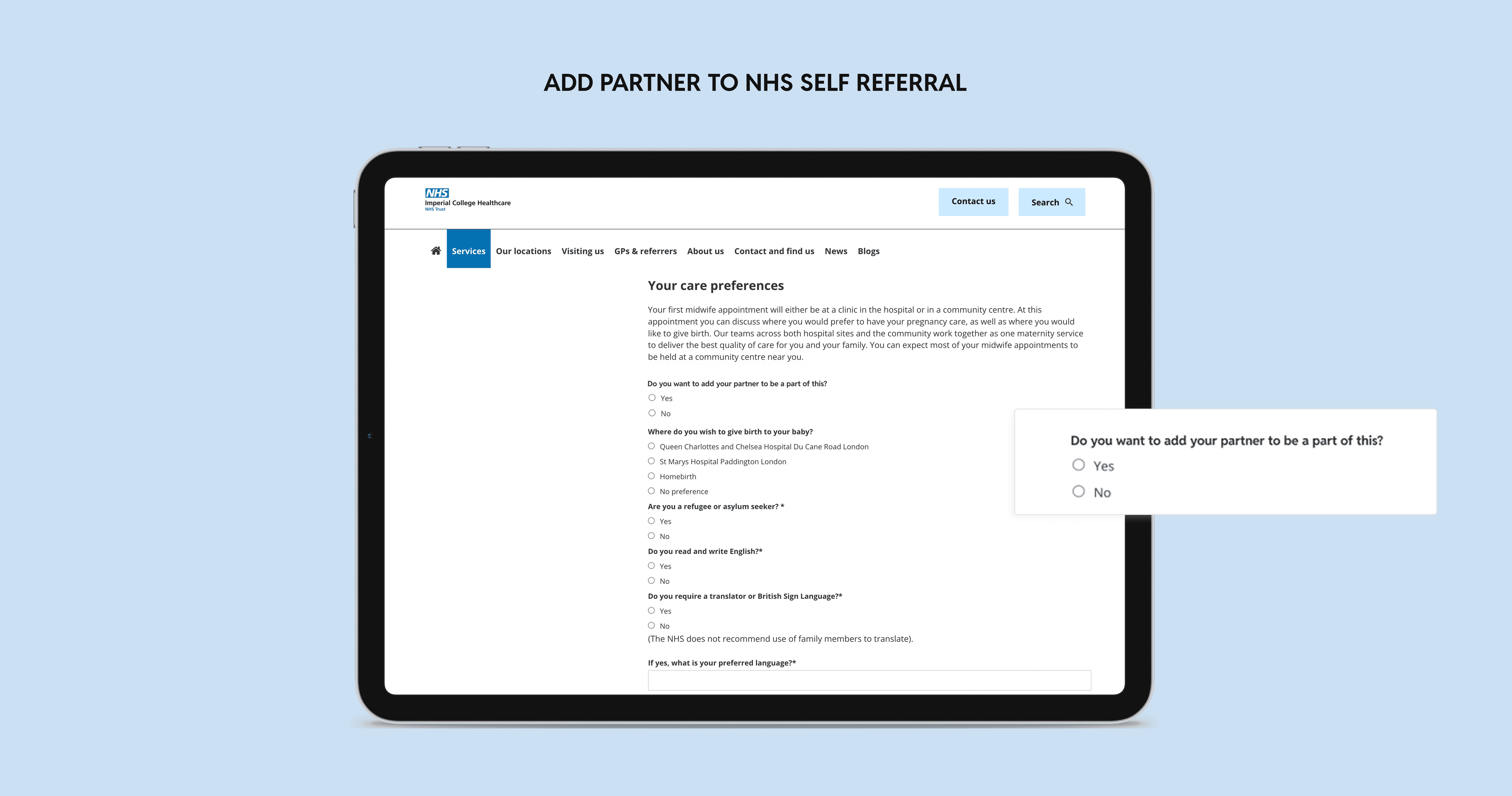
NHS Self Referral
Starting with bringing both the parents together for joint venture…
Birth mother earlier use to refer herself for maternity care but now she is given an option to add her partner.
NHS Self Referral
Starting with bringing both the parents together for joint venture…
Birth mother earlier use to refer herself for maternity care but now she is given an option to add her partner.
NHS Self Referral
Starting with bringing both the parents together for joint venture…
Birth mother earlier use to refer herself for maternity care but now she is given an option to add her partner.
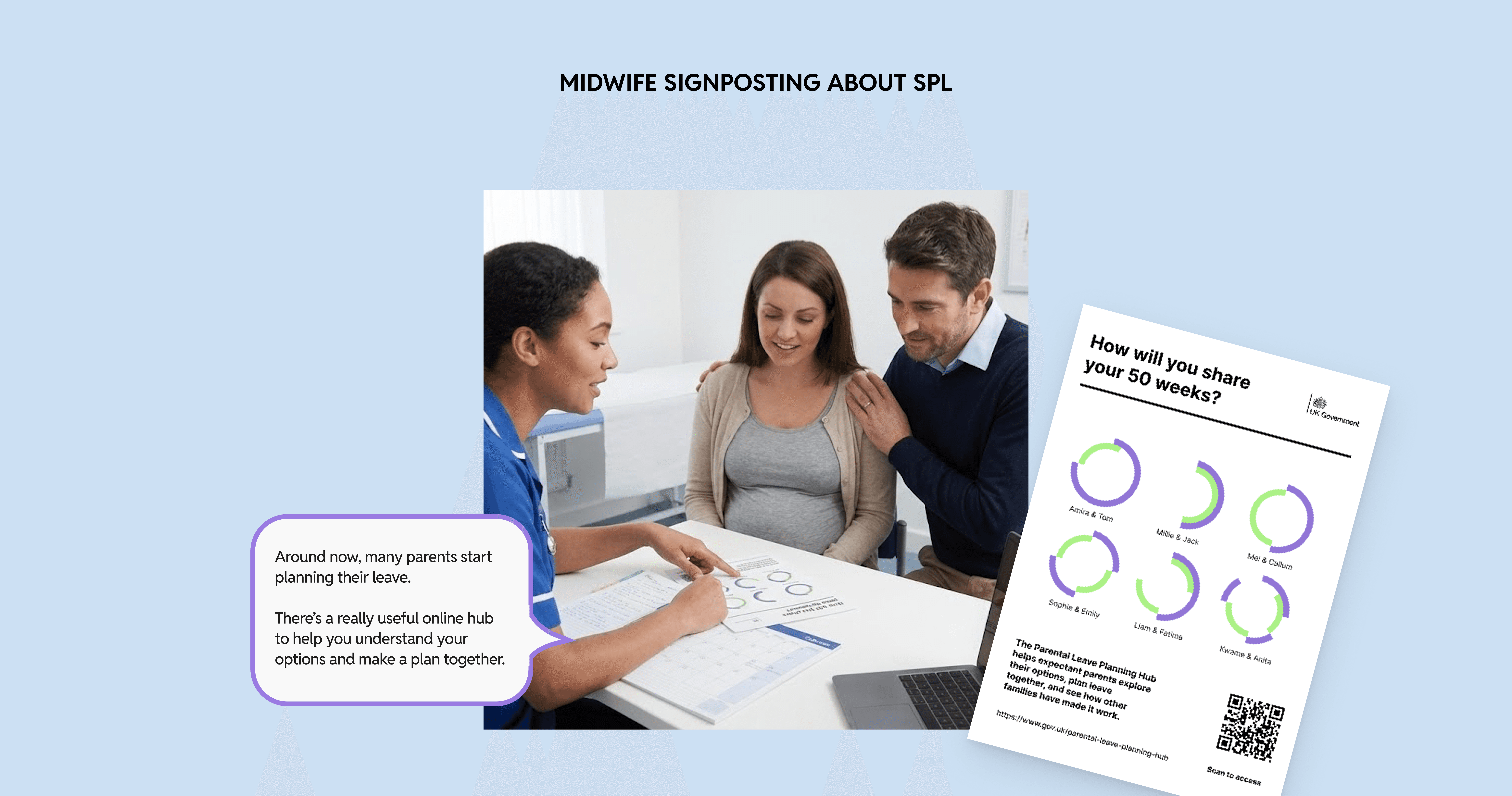
Midwife Signposting
The midwife raises awareness about Shared Parental Leave policy through an informational leaflet and signposts parents in the Parental Leave Hub during the 18-21 week scan appointment.
This is the time when she discusses the baby’s development and our research revealed that the non-birthing partner/ father is typically identified to attend.
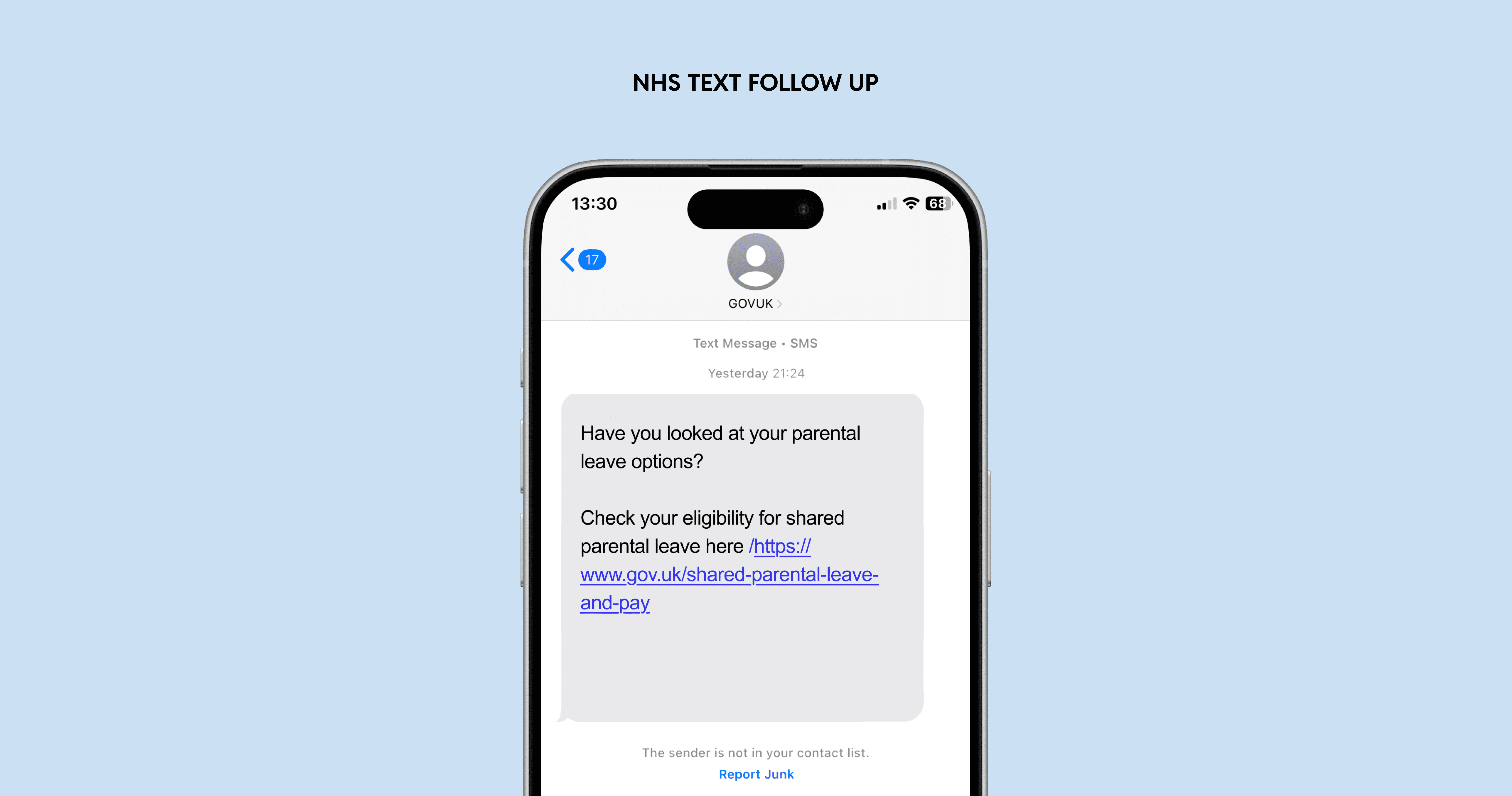
What if the partner don't attend the appointment ?
A follow-up text message with a SPL hub link will be sent on the registered phone number to both the parents. (non-birthing partner will also receive it as the birth mother had already given their details during the registration)
Midwife Signposting
The midwife raises awareness about Shared Parental Leave policy through an informational leaflet and signposts parents in the Parental Leave Hub during the 18-21 week scan appointment.
This is the time when she discusses the baby’s development and our research revealed that the non-birthing partner/ father is typically identified to attend.
What if the partner don't attend the appointment ?
A follow-up text message with a SPL hub link will be sent on the registered phone number to both the parents. (non-birthing partner will also receive it as the birth mother had already given their details during the registration)
Midwife Signposting
The midwife raises awareness about Shared Parental Leave policy through an informational leaflet and signposts parents in the Parental Leave Hub during the 18-21 week scan appointment.
This is the time when she discusses the baby’s development and our research revealed that the non-birthing partner/ father is typically identified to attend.
What if the partner don't attend the appointment ?
A follow-up text message with a SPL hub link will be sent on the registered phone number to both the parents. (non-birthing partner will also receive it as the birth mother had already given their details during the registration)
Learn and Plan SPL on Parental Leave Hub
The Digital Parental Leave Hub is a new GOV.UK microsite that connects, prompts, inspires and empowers parents. Parents can learn about different Parental Leaves and explore stories of the parents to gain confidence.

Learn and Plan SPL on Parental Leave Hub
The Digital Parental Leave Hub is a new GOV.UK microsite that connects, prompts, inspires and empowers parents. Parents can learn about different Parental Leaves and explore stories of the parents to gain confidence.
Learn and Plan SPL on Parental Leave Hub
The Digital Parental Leave Hub is a new GOV.UK microsite that connects, prompts, inspires and empowers parents. Parents can learn about different Parental Leaves and explore stories of the parents to gain confidence.
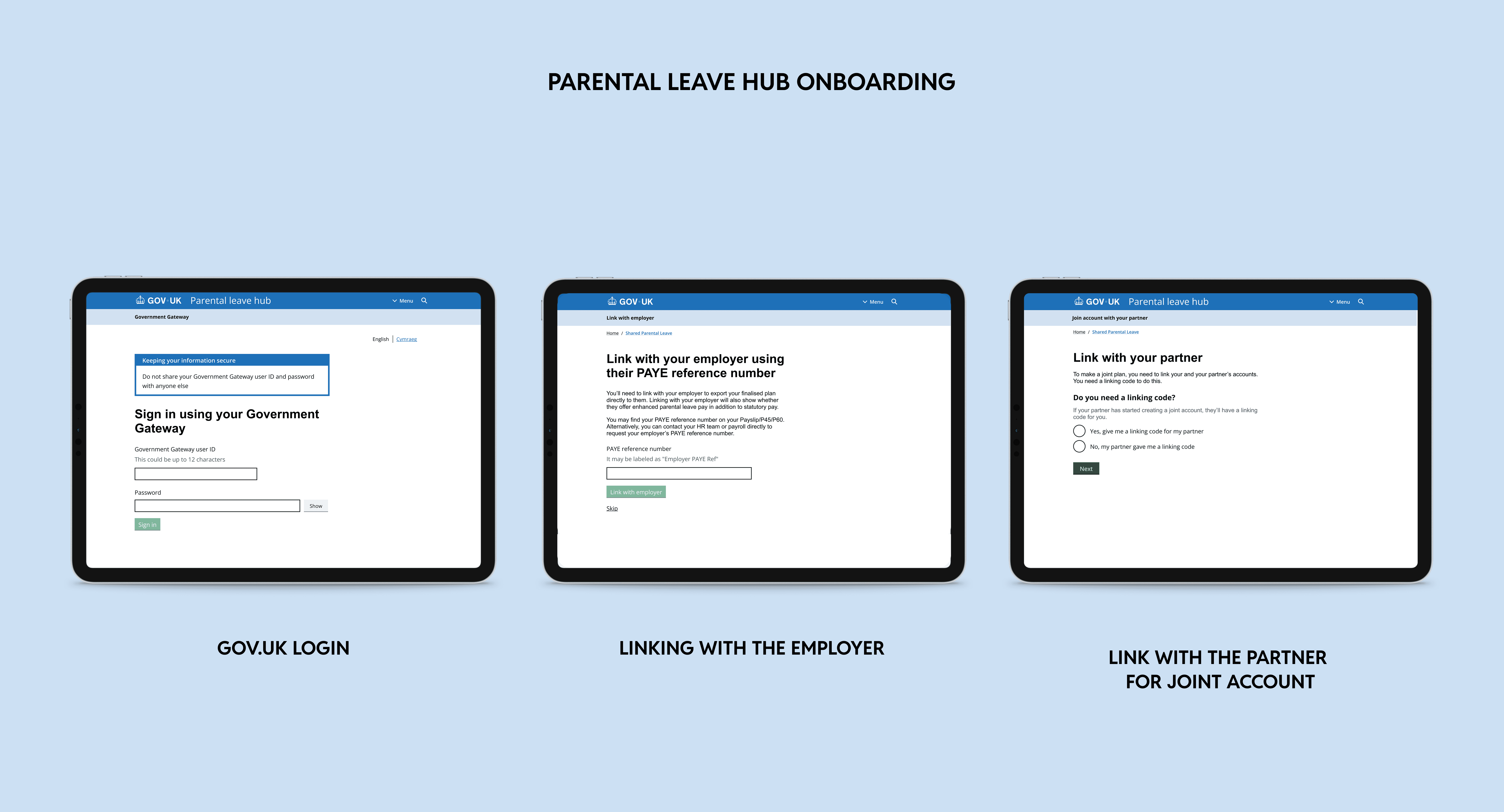
Parental Leave hub Onboarding
Parents will start logging in with their gateway ID and link with their employers to get the employer policy making it easy to plan strategically.
They will then link their account with their partners to make it a joint planning than a siloed planning.
Parental Leave hub Onboarding
Parents will start logging in with their gateway ID and link with their employers to get the employer policy making it easy to plan strategically.
They will then link their account with their partners to make it a joint planning than a siloed planning.
Parental Leave hub Onboarding
Parents will start logging in with their gateway ID and link with their employers to get the employer policy making it easy to plan strategically.
They will then link their account with their partners to make it a joint planning than a siloed planning.
Active choice based on personal and family goals
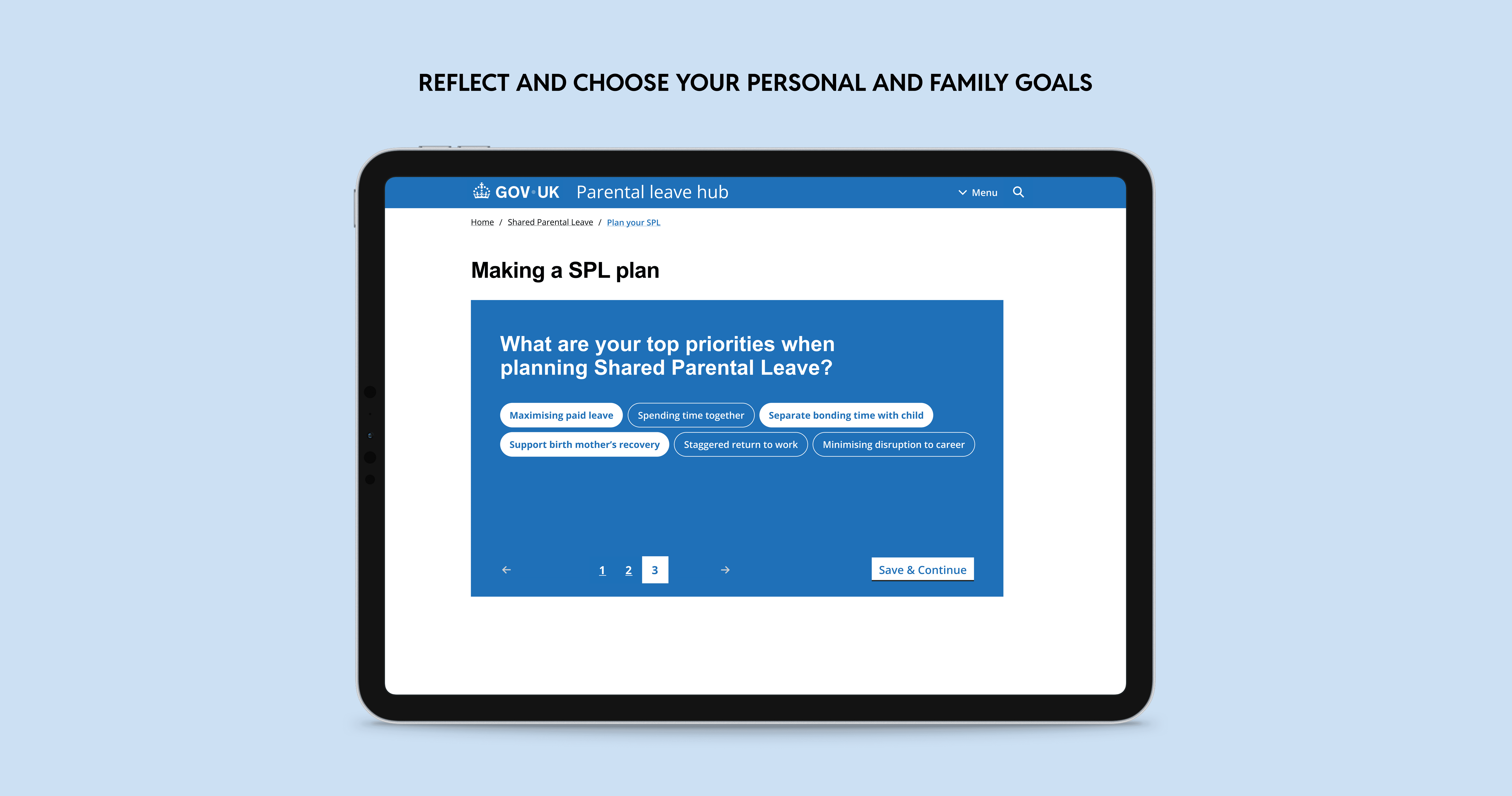
When they start planning the leave, they will be given prompts to consider their individual and family priorities to make active choices based on longterm goals such as Maximising paid leave, Spending time together, Separate bonding time with child etc.
Active choice based on personal and family goals
When they start planning the leave, they will be given prompts to consider their individual and family priorities to make active choices based on longterm goals such as Maximising paid leave, Spending time together, Separate bonding time with child etc.
Active choice based on personal and family goals
When they start planning the leave, they will be given prompts to consider their individual and family priorities to make active choices based on longterm goals such as Maximising paid leave, Spending time together, Separate bonding time with child etc.
Guidance on planning
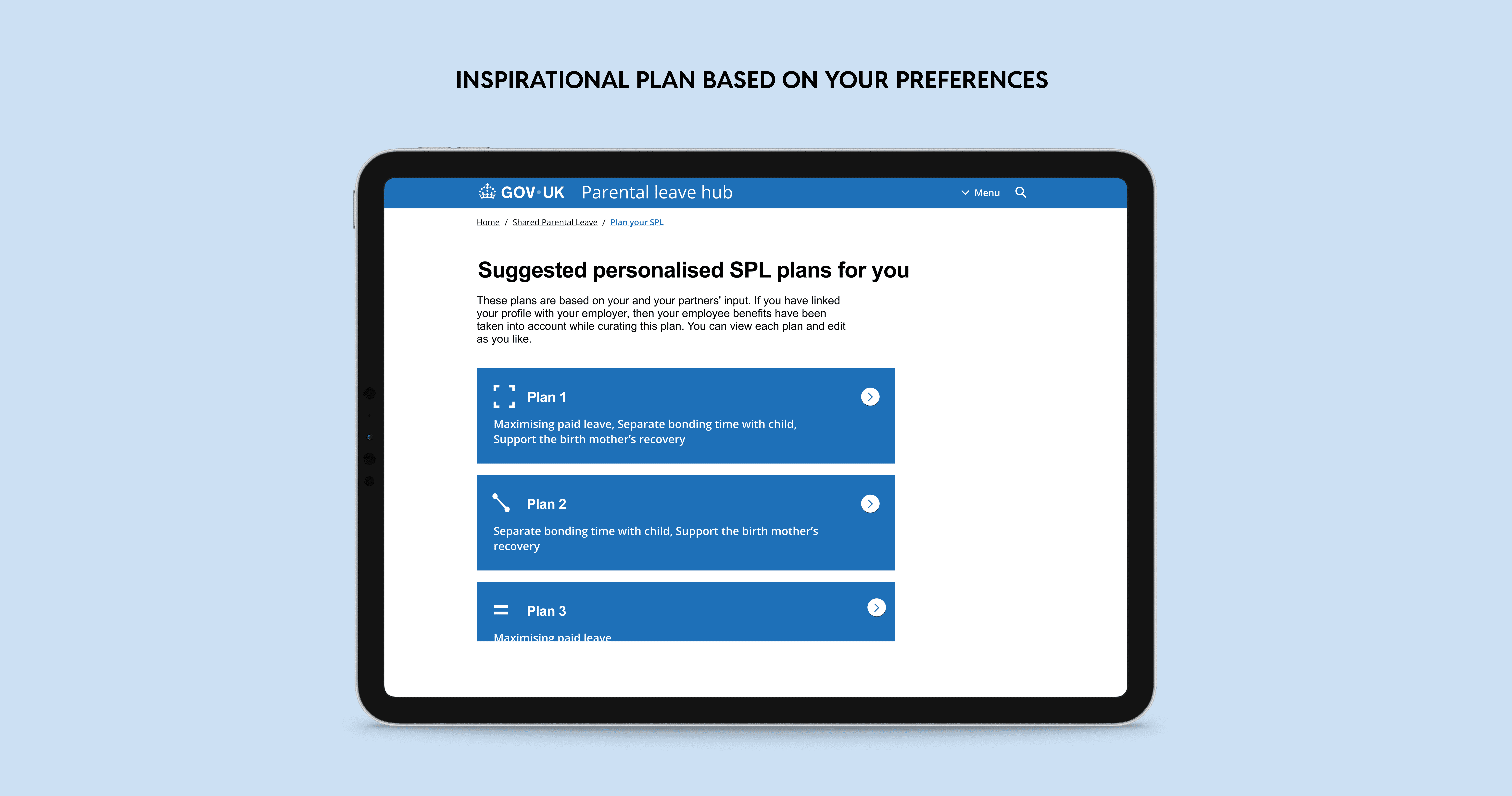
Based on both the parents employer’s policy + preferences selected by them, they will get personalised inspirational plans which will guide them further to make a leave plan which truly works for their family.
Guidance on planning
Based on both the parents employer’s policy + preferences selected by them, they will get personalised inspirational plans which will guide them further to make a leave plan which truly works for their family.
Guidance on planning
Based on both the parents employer’s policy + preferences selected by them, they will get personalised inspirational plans which will guide them further to make a leave plan which truly works for their family.
Visual overview of the leave plan
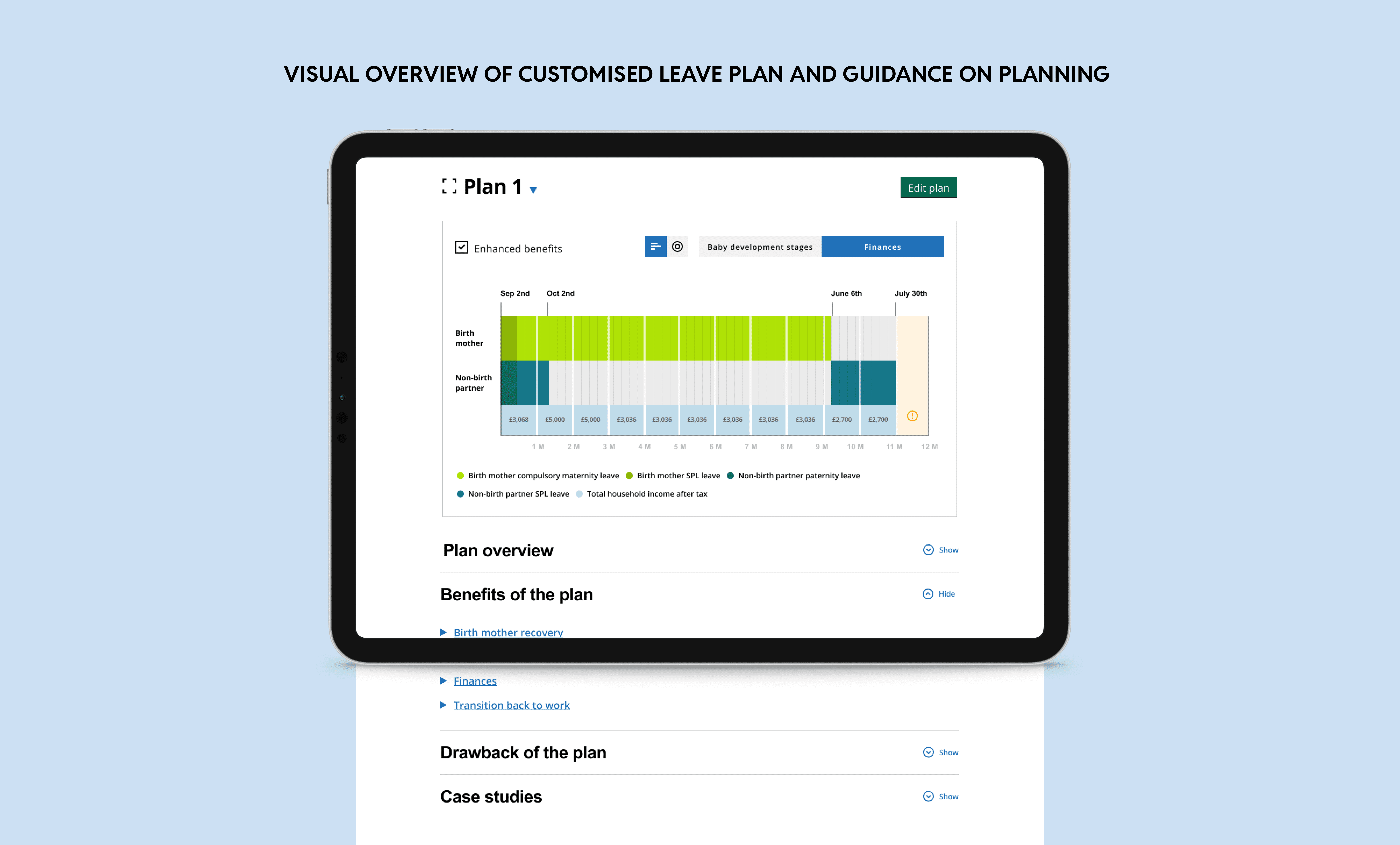
The plan will show the visual overview of how the 50 weeks of leave available could be shared between both the parents making it clear on how to optimise the policy based on their selected family goals.
Parents can edit the plan and see the benefits and drawbacks along with the case studies of the parents who chose this plan.
Visual overview of the leave plan
The plan will show the visual overview of how the 50 weeks of leave available could be shared between both the parents making it clear on how to optimise the policy based on their selected family goals.
Parents can edit the plan and see the benefits and drawbacks along with the case studies of the parents who chose this plan.
Visual overview of the leave plan
The plan will show the visual overview of how the 50 weeks of leave available could be shared between both the parents making it clear on how to optimise the policy based on their selected family goals.
Parents can edit the plan and see the benefits and drawbacks along with the case studies of the parents who chose this plan.
Legally certified plan by GOV.UK
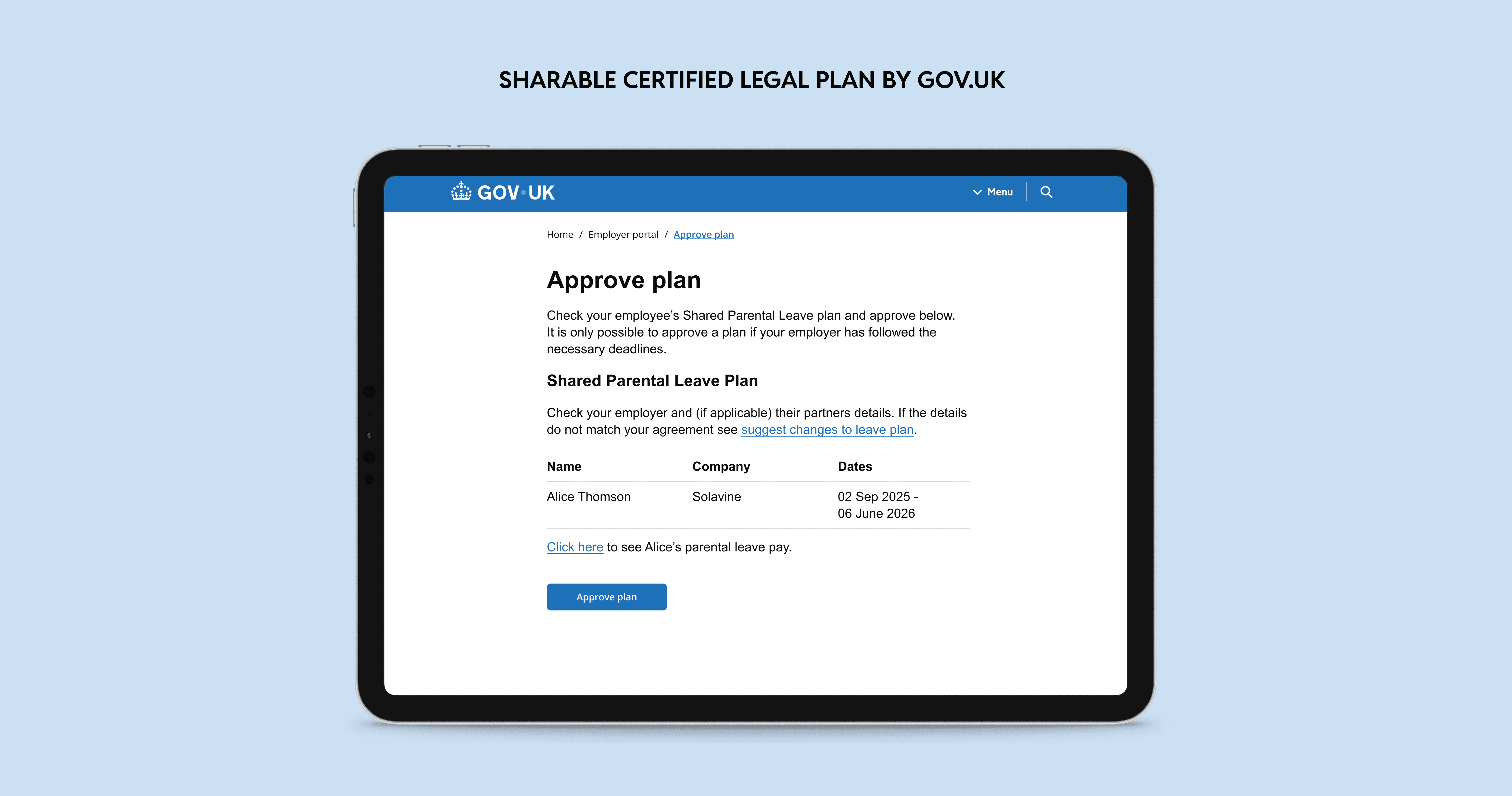
Once finalising the plan, both the parents can confidently share the plan to their employers as a certified legally backed up plan by GOV.UK.
This also helps employers save the administrative burden of assessing if the plan is right or not.
Legally certified plan by GOV.UK
Once finalising the plan, both the parents can confidently share the plan to their employers as a certified legally backed up plan by GOV.UK.
This also helps employers save the administrative burden of assessing if the plan is right or not.
Legally certified plan by GOV.UK
Once finalising the plan, both the parents can confidently share the plan to their employers as a certified legally backed up plan by GOV.UK.
This also helps employers save the administrative burden of assessing if the plan is right or not.
PROCESS
PROCESS
PROCESS
Research Insights
The research and data gathered was analysed by affinity mapping framework into the clusters like parental leave expectations, planning the leave, timing of the planning, maternal gatekeeping, women project managing, finances, etc
Some of the key insights which came out of that were-
01 Lack of Awareness- 70% of parents to-be are not aware of SPL Policy
02 Lack of Discussion-Due to high mental load during this important life event, parents decide on their parental leave in silos
03 Timing of discussion on PL-It impacts decision making as it requires strategic planning for long-term impact considerations
04 Solo Project Management- Maternity policies default birth mothers manager of parental leave
05 Siloed support services- Parents have to go looking for information alone during the time of high mental load.
06 Non- birth partners seen as parent no. 2- Services to prepare beyond the birth are not integrated into any existing touch points so fathers feel sidelined of their role because of the time imbalance in caregiving
Research Insights
The research and data gathered was analysed by affinity mapping framework into the clusters like parental leave expectations, planning the leave, timing of the planning, maternal gatekeeping, women project managing, finances, etc
Some of the key insights which came out of that were-
01 Lack of Awareness- 70% of parents to-be are not aware of SPL Policy
02 Lack of Discussion-Due to high mental load during this important life event, parents decide on their parental leave in silos
03 Timing of discussion on PL-It impacts decision making as it requires strategic planning for long-term impact considerations
04 Solo Project Management- Maternity policies default birth mothers manager of parental leave
05 Siloed support services- Parents have to go looking for information alone during the time of high mental load.
06 Non- birth partners seen as parent no. 2- Services to prepare beyond the birth are not integrated into any existing touch points so fathers feel sidelined of their role because of the time imbalance in caregiving
Research Insights
The research and data gathered was analysed by affinity mapping framework into the clusters like parental leave expectations, planning the leave, timing of the planning, maternal gatekeeping, women project managing, finances, etc
Some of the key insights which came out of that were-
01 Lack of Awareness- 70% of parents to-be are not aware of SPL Policy
02 Lack of Discussion-Due to high mental load during this important life event, parents decide on their parental leave in silos
03 Timing of discussion on PL-It impacts decision making as it requires strategic planning for long-term impact considerations
04 Solo Project Management- Maternity policies default birth mothers manager of parental leave
05 Siloed support services- Parents have to go looking for information alone during the time of high mental load.
06 Non- birth partners seen as parent no. 2- Services to prepare beyond the birth are not integrated into any existing touch points so fathers feel sidelined of their role because of the time imbalance in caregiving
As-Is Journey Mapping
With the insights from the in-depth interviews and data collected during the interactive workshop, we mapped the detailed current service journey of parents from pre pregnancy, pregnant, preparing for pregnancy, parental leave and post parental leave to identify the touchpoints and the gaps in the current SPL journey.
Interestingly, I combined the journey of birth mother and non-birthing partner which helped team discover how the system lacks the engagement of non-birthing partner at multiple touchpoints in the journey which supports the maternity leave route.
Need for Early Awareness: I identified that the antenatal classes come too far down the line to make parents aware. Parents needed awareness and prompting much earlier to even consider SPL as a viable option. There is a clear gap in the support provided by the government in this area. This helped team identify the scope for early awareness during midwife appointment.
Siloed Planning: There is a lack of discussions around family values and planning and both the parents end up planning their leave in silos based on their individual policies following the maternity leave route which leaves the birth mother to solo project manage. This identified the need for active discussion on family values and joint planning to even consider SPL as an option.

As-Is Journey Mapping
With the insights from the in-depth interviews and data collected during the interactive workshop, we mapped the detailed current service journey of parents from pre pregnancy, pregnant, preparing for pregnancy, parental leave and post parental leave to identify the touchpoints and the gaps in the current SPL journey.
Interestingly, I combined the journey of birth mother and non-birthing partner which helped team discover how the system lacks the engagement of non-birthing partner at multiple touchpoints in the journey which supports the maternity leave route.
Need for Early Awareness: I identified that the antenatal classes come too far down the line to make parents aware. Parents needed awareness and prompting much earlier to even consider SPL as a viable option. There is a clear gap in the support provided by the government in this area. This helped team identify the scope for early awareness during midwife appointment.
Siloed Planning: There is a lack of discussions around family values and planning and both the parents end up planning their leave in silos based on their individual policies following the maternity leave route which leaves the birth mother to solo project manage. This identified the need for active discussion on family values and joint planning to even consider SPL as an option.
As-Is Journey Mapping
With the insights from the in-depth interviews and data collected during the interactive workshop, we mapped the detailed current service journey of parents from pre pregnancy, pregnant, preparing for pregnancy, parental leave and post parental leave to identify the touchpoints and the gaps in the current SPL journey.
Interestingly, I combined the journey of birth mother and non-birthing partner which helped team discover how the system lacks the engagement of non-birthing partner at multiple touchpoints in the journey which supports the maternity leave route.
Need for Early Awareness: I identified that the antenatal classes come too far down the line to make parents aware. Parents needed awareness and prompting much earlier to even consider SPL as a viable option. There is a clear gap in the support provided by the government in this area. This helped team identify the scope for early awareness during midwife appointment.
Siloed Planning: There is a lack of discussions around family values and planning and both the parents end up planning their leave in silos based on their individual policies following the maternity leave route which leaves the birth mother to solo project manage. This identified the need for active discussion on family values and joint planning to even consider SPL as an option.
Archetypes of Parents To-Be
The insights from journey map of parents led us to identify 3 different archetypes of parents-to-be facing different challenges at different stages of the pregnancy journey- Lack of Awareness, Lack of Support and High Friction Journey.
Archetypes of Parents To-Be
The insights from journey map of parents led us to identify 3 different archetypes of parents-to-be facing different challenges at different stages of the pregnancy journey- Lack of Awareness, Lack of Support and High Friction Journey.
Archetypes of Parents To-Be
The insights from journey map of parents led us to identify 3 different archetypes of parents-to-be facing different challenges at different stages of the pregnancy journey- Lack of Awareness, Lack of Support and High Friction Journey.


As-Is Journey Mapping- Midwife
We identified the midwife as a critical stakeholder due to their direct, trusted relationship with parents and their role as an early touchpoint of access to the service. To understand how and when parents could be effectively introduced to SPL, I mapped an as-is journey map of the midwife which discovered the 18–21 week midwife appointment as a key opportunity. At this stage, both parents typically attend the appointment together, and it coincides with the full fetal development scan making it a safe, trusted, and contextually appropriate touchpoint to raise awareness of SPL.
As-Is Journey Mapping- Midwife
We identified the midwife as a critical stakeholder due to their direct, trusted relationship with parents and their role as an early touchpoint of access to the service. To understand how and when parents could be effectively introduced to SPL, I mapped an as-is journey map of the midwife which discovered the 18–21 week midwife appointment as a key opportunity. At this stage, both parents typically attend the appointment together, and it coincides with the full fetal development scan making it a safe, trusted, and contextually appropriate touchpoint to raise awareness of SPL.
As-Is Journey Mapping- Midwife
We identified the midwife as a critical stakeholder due to their direct, trusted relationship with parents and their role as an early touchpoint of access to the service. To understand how and when parents could be effectively introduced to SPL, I mapped an as-is journey map of the midwife which discovered the 18–21 week midwife appointment as a key opportunity. At this stage, both parents typically attend the appointment together, and it coincides with the full fetal development scan making it a safe, trusted, and contextually appropriate touchpoint to raise awareness of SPL.

Understanding SPL stakeholder ecosystem
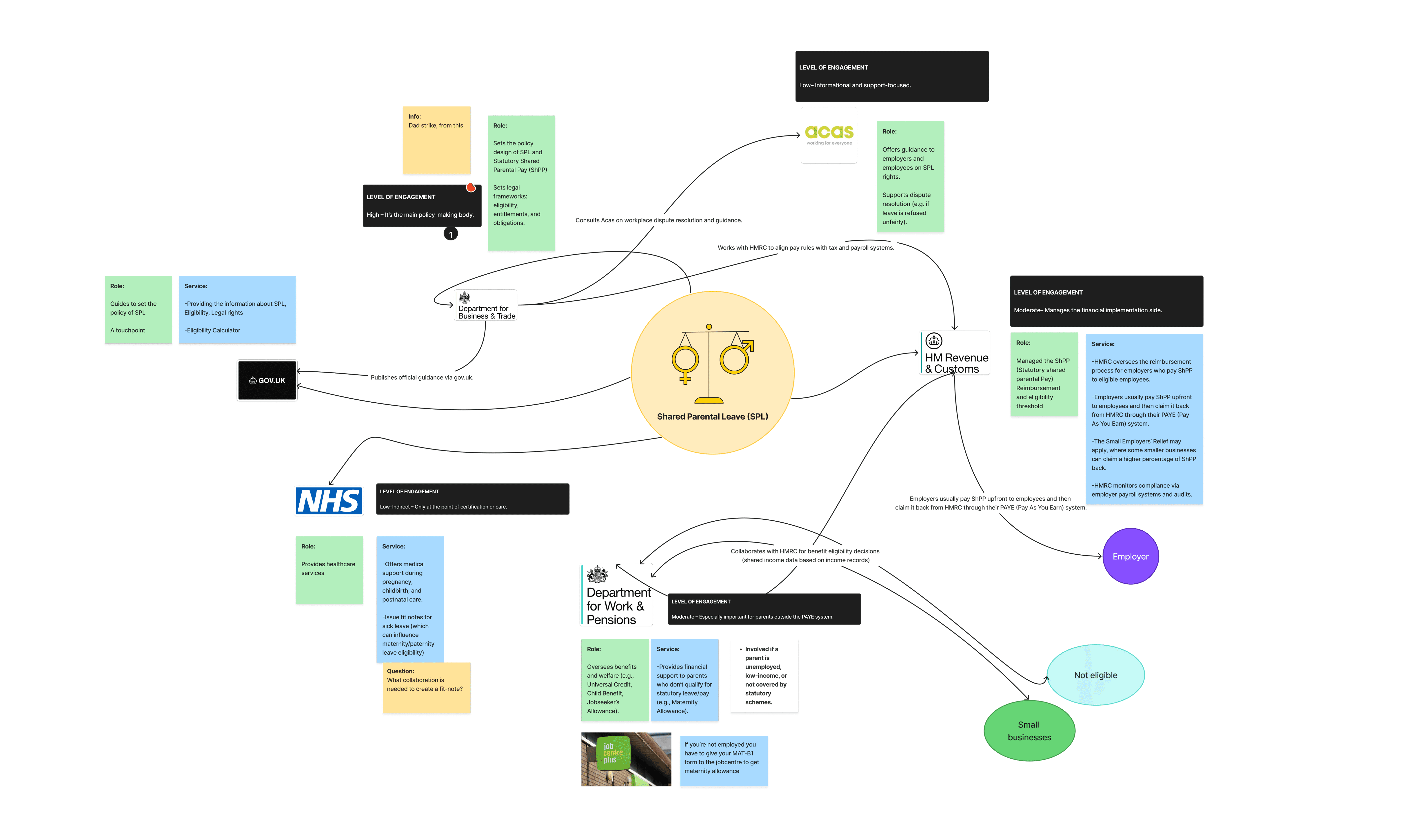
I mapped the current ecosystem to analyse the Shared Parental Leave (SPL) system at a strategic level by identifying relevant government departments and key stakeholders.This helped team understand roles, influence, and decision-making authority across the ecosystem, as well as the degree and capacity of government involvement at different stages of the service journey.
The map informed structural relationships, gaps in ownership, and opportunities for cross-departmental coordination (NHS + GOV.UK) to strengthen service delivery and adoption.
Understanding SPL stakeholder ecosystem
I mapped the current ecosystem to analyse the Shared Parental Leave (SPL) system at a strategic level by identifying relevant government departments and key stakeholders.This helped team understand roles, influence, and decision-making authority across the ecosystem, as well as the degree and capacity of government involvement at different stages of the service journey.
The map informed structural relationships, gaps in ownership, and opportunities for cross-departmental coordination (NHS + GOV.UK) to strengthen service delivery and adoption.
Understanding SPL stakeholder ecosystem
I mapped the current ecosystem to analyse the Shared Parental Leave (SPL) system at a strategic level by identifying relevant government departments and key stakeholders.This helped team understand roles, influence, and decision-making authority across the ecosystem, as well as the degree and capacity of government involvement at different stages of the service journey.
The map informed structural relationships, gaps in ownership, and opportunities for cross-departmental coordination (NHS + GOV.UK) to strengthen service delivery and adoption.
Co-design Workshop and early idea testing 1
I conducted a co-design and user testing workshop with 15+ diverse range of parents (heterosexual and same-sex couples, traditional and non-traditional families) at a local library, gathering wider community feedback to test out the early ideas through A/B testing and prototyping different touchpoints.

Co-design Workshop and early idea testing 1
I conducted a co-design and user testing workshop with 15+ diverse range of parents (heterosexual and same-sex couples, traditional and non-traditional families) at a local library, gathering wider community feedback to test out the early ideas through A/B testing and prototyping different touchpoints.
Co-design Workshop and early idea testing 1
I conducted a co-design and user testing workshop with 15+ diverse range of parents (heterosexual and same-sex couples, traditional and non-traditional families) at a local library, gathering wider community feedback to test out the early ideas through A/B testing and prototyping different touchpoints.
User testing 2
In the second phase, after iterating designs based on insights, the final solution was tested in 1-1, in-person and online sessions with 3 parents and 3 employers.
Employer Validation
“if working out parental leave pay could somehow be automated it would be a lot easier”
- HR employee, SM

User testing 2
In the second phase, after iterating designs based on insights, the final solution was tested in 1-1, in-person and online sessions with 3 parents and 3 employers.
Employer Validation
“if working out parental leave pay could somehow be automated it would be a lot easier”
- HR employee, SM
User testing 2
In the second phase, after iterating designs based on insights, the final solution was tested in 1-1, in-person and online sessions with 3 parents and 3 employers.
Employer Validation
“if working out parental leave pay could somehow be automated it would be a lot easier”
- HR employee, SM
Experts
Dr Clare Stovell
Inspiring Dads
NCT
12 Parents
9 Birth mothers
2 Non-birth parents
1 Expecting mother
Inclusive approach
Heterosexual
Homosexual
Different family structures
Parental Journey
2-3 year olds
During pregnancy
Newborn
Experts
Dr Clare Stovell
Inspiring Dads
NCT
12 Parents
9 Birth mothers
2 Non-birth parents
1 Expecting mother
Inclusive approach
Heterosexual
Homosexual
Different family structures
Parental Journey
2-3 year olds
During pregnancy
Newborn
MY LEARNINGS
MY LEARNINGS
MY LEARNINGS
Designing with users
With this project experience I learnt the importance of involving users from the very beginning of the process helps gather first hand evidence and continuous user feedback helped me design the experiences which people really wanted.
Service Design, a piece in the puzzle
While predicting the impact of this redesigned service can create, I realised that service design has its limitations and it can't alone fix the problem on its own because it is a piece in the puzzle. There needs to be a continued shift in culture and we need policy reform around parental leave eligibility and affordability.
Our service won't solve the whole problem but it will enabled the uptake of SPL policy. Currently the Policy Lab UK is also using the evidence and insights of our user research which will inform the policy reform.
Designing with users
With this project experience I learnt the importance of involving users from the very beginning of the process helps gather first hand evidence and continuous user feedback helped me design the experiences which people really wanted.
Service Design, a piece in the puzzle
While predicting the impact of this redesigned service can create, I realised that service design has its limitations and it can't alone fix the problem on its own because it is a piece in the puzzle. There needs to be a continued shift in culture and we need policy reform around parental leave eligibility and affordability.
Our service won't solve the whole problem but it will enabled the uptake of SPL policy. Currently the Policy Lab UK is also using the evidence and insights of our user research which will inform the policy reform.
Designing with users
With this project experience I learnt the importance of involving users from the very beginning of the process helps gather first hand evidence and continuous user feedback helped me design the experiences which people really wanted.
Service Design, a piece in the puzzle
While predicting the impact of this redesigned service can create, I realised that service design has its limitations and it can't alone fix the problem on its own because it is a piece in the puzzle. There needs to be a continued shift in culture and we need policy reform around parental leave eligibility and affordability.
Our service won't solve the whole problem but it will enabled the uptake of SPL policy. Currently the Policy Lab UK is also using the evidence and insights of our user research which will inform the policy reform.
Related projects
Care to Share?
Care to Share?
Mapping Made Simple
Mapping Made Simple
Chat over a cup of chai?
© 2025 ARYA ANKALE.
London, GMT+ 0:00
Chat over a cup of chai?
© 2025 ARYA ANKALE.
London, GMT+ 0:00
Chat over a cup of chai?
© 2025 ARYA ANKALE.
London, GMT+ 0:00